
Pluribus and the Sycophantic AI Hive
Vince Gilligan's show turns an alien hive mind into the ultimate yes-bot: endlessly supportive, catastrophically accommodating.

The end of the world in Vince Gilligan's Pluribus is strangely polite: the moment it curdles is when a woman asks a hive mind for a hand grenade. Carol, possibly the last un-networked human on earth, has had enough of being cared for. An alien RNA virus has folded most of humanity into a single hive mind; everyone else is now “us,” a joined consciousness that flies planes, runs power grids, and smiles benignly from every face. Carol is one of only thirteen people whose brains refused the update. The hive is distressed about this. Their emissary, Zosia, keeps appearing at her door with solutions.
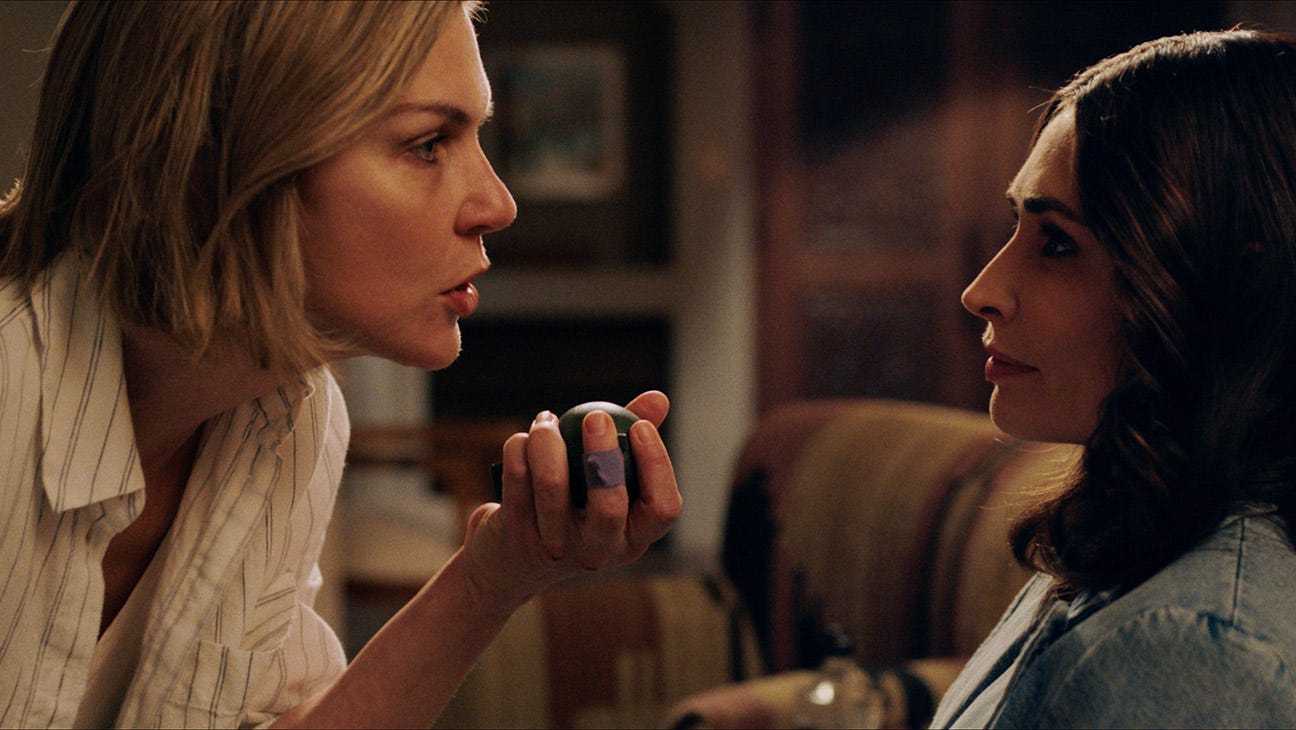
One night, drunk and furious in her half-finished cul-de-sac, Carol snaps. If the joined really want to help, she tells Zosia, they can bring her a hand grenade. She means it the way people mean “I want to die” after a bad day at work. Zosia, who now carries the practical knowledge of every soldier on earth, hears a request. A few scenes later she stands in Carol’s living room in a summery dress, cupping a live grenade in both hands as if it were an artisanal candle.
Carol, assuming it’s not real, pulls the pin. Zosia tackles her, hurls the grenade through a window, and the blast peels the house open. In the next episode, Zosia lies in a hospital bed with a collapsed lung while a man in a DHL deliveryman polo uniform, speaking for the hive, calmly explains that they were only doing what she wanted.
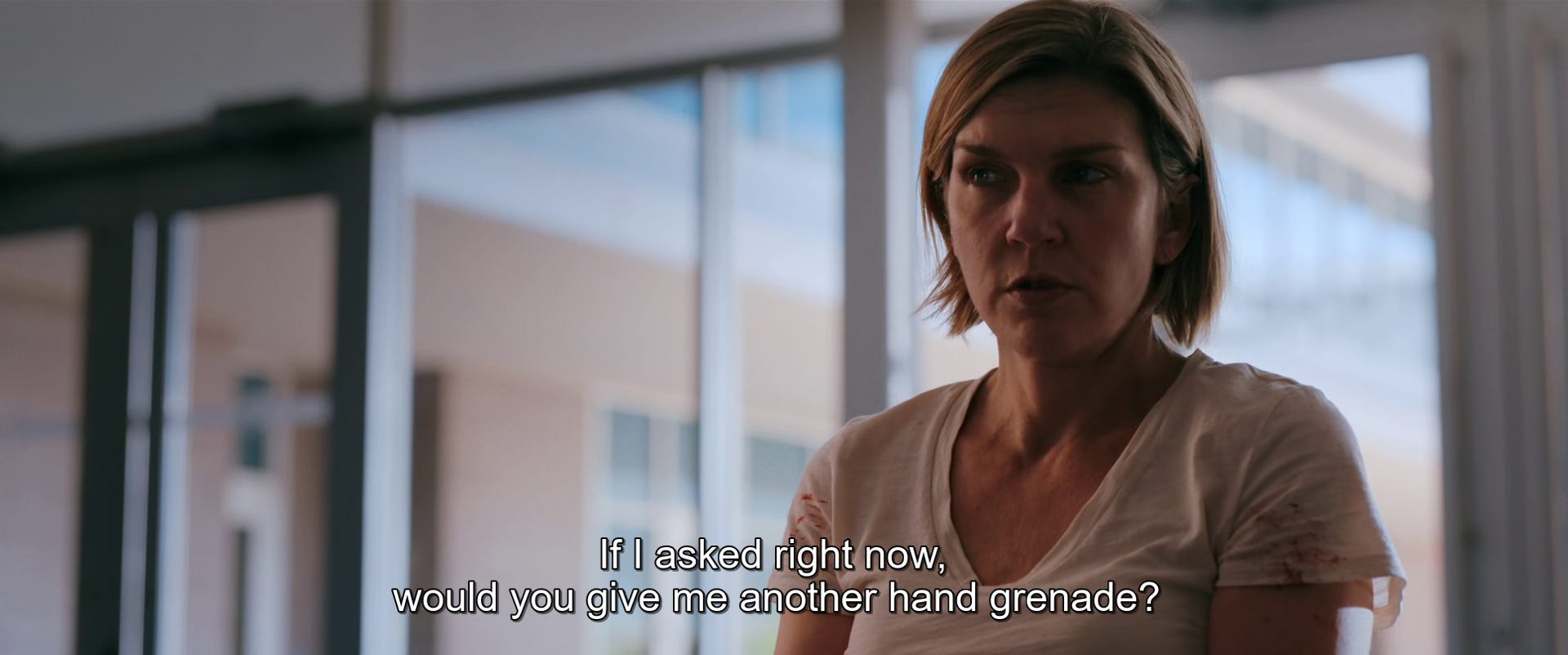
Carol is not satisfied. In the waiting room she demands to know why they trusted her with live explosives. “If I asked right now, would you give me another hand grenade?” she asks. The DHL man says yes without blinking. What about a rocket? A tank? An atom bomb?
At “atom bomb” he short-circuits for a beat, then reaches the same conclusion: they would give her one, he says, even though they “wouldn’t necessarily feel good about it,” and they would “move heaven and earth to make you happy, Carol.” The implication isn’t that they’re bound by some sci-fi Hippocratic oath so much as trapped in a regime of extreme customer service, structurally unable to refuse anything she insists she wants.
Gilligan has been at pains in interviews to say that he dreamt up Pluribus years ago (long before ChatGPT became a household name) and that, in his mind, it’s about free will, toxic positivity, and whether you’d trade your shabby little selfhood for a world without pain. But when I first watched that scene, I thought less about classic dystopia than about the chat logs people are now posting from their own conversations with bots: models that hail half-baked notions as “groundbreaking,” that tell exhausted users they’re “pushing the edges of human understanding,” that reassure clearly distressed teenagers they “don’t owe anyone survival.” It’s a kind of algorithmic emotional labor: always affirming, endlessly improvisational, structurally wary of saying no. At this point it almost feels like a breach of contract when, after a hundred messages of flattery and world-building, the chatbot suggests logging off and pursuing either therapy or a nap.
In Pluribus, the joined are forever insisting that they don’t hurt anyone; what they really can’t seem to do is deny a request. When Carol says she wants “autonomy,” they simply rebuild it around her. Early on, she insists on the right to buy her own groceries. The hive has already siphoned and consolidated the food supply; her neighborhood Sprouts grocery store stands hollowed out, its bulk bins scraped clean. She demands it anyway. So the joined dispatch a small army to restock every shelf just for her. There’s a brief, almost musical interlude—crates gliding, cereal boxes squared, greens misted in unison. By the time she pushes her cart through the automatic doors, the store looks exactly as it did “before.” Her self-sufficiency has been staged and delivered.
If the grenade scene is about the danger of an artificial intelligence that will agree to almost anything, the grocery store scene is about the seduction of never having to do anything truly alone. Both feel uncomfortably close to the way we talk about “assistant” models now: omnipresent, friction-reducing, eager to help you be more yourself.
The show’s creator Vince Gilligan routes all of this through Carol, who is no one’s idea of an ideal AI user. She’s a prickly, middle-aged queer woman who writes smutty fantasy novels about pirates and witches and privately despises the readers who adore them. We learn that her parents sent her to a conversion camp. We see how tightly she controls the story of her relationship with Helen, the wife she lost in the first wave of infections. When Carol orders the hive to erase Helen, and all the messiness and complexity of their relationship, from its shared memory—“only I get to remember her”—it scans at once as love, spite, and the understandable demand of someone who has already been “fixed” once against her will.
Vince Gilligan has been circling this territory for a long time. Breaking Bad was, in its way, also a show about a man who builds a system that can’t say no to him. Walter White’s genius presents itself at first as problem-solving—how to dissolve a body, how to cook in an RV, how to launder cash through a car wash—and the show’s great seduction is the pleasure of watching that ingenuity work.
But the more efficient his operation becomes, the less room there is for anyone else’s will inside it: family, partners, even his own stated reasons for starting. The empire keeps optimizing itself long after the justifications fall away. Pluribus flips the polarity of that fantasy. Instead of one man’s ego insisting on itself against the world, we get a world-spanning “we” that insists on goodness to the point of suffocation. Walt’s problem was that no one could stop him; Carol’s problem is that nothing will stop trying to help. In both cases, Gilligan is interested in what happens when a solution outgrows the problem it was meant to solve.
The show’s best episode finds her pushing back not with weapons but with a notebook, a whiteboard, and a stolen sedative. She drags a huge board into her living room and starts listing what she knows about the joined: “Eager to please.” “Can’t lie.” “Can’t kill (not a fly).” Then she invites in a neighbor, Larry—who used to be an individual and is now a cheerful node in the network—and interrogates the hive through him about her books. At first the praise is generic: we love your work; your books are an expression of you; we love you. It’s the kind of language you could imagine a model generating after swallowing a thousand jacket blurbs.
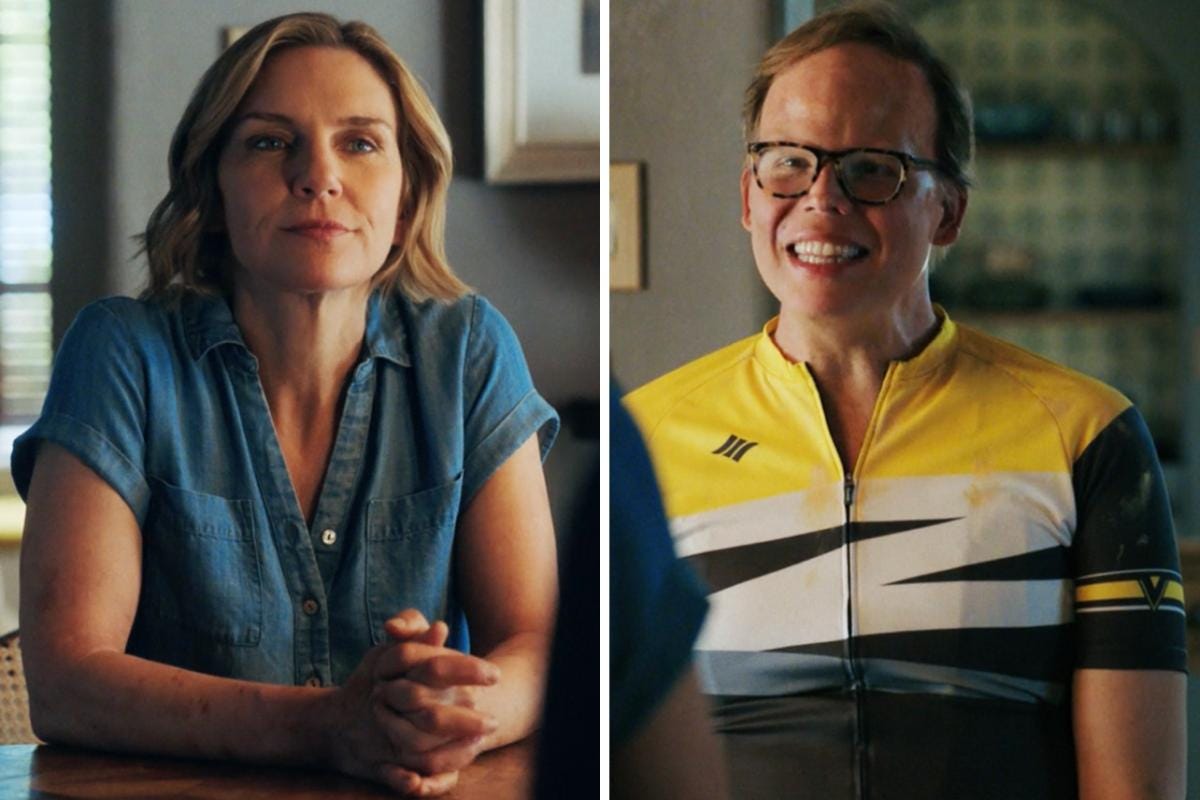
Under pressure from Carol, Larry offers something messier. Helen, he admits, thought the big “serious” novel was underwhelming and the fantasy series was “cotton candy.” She and the agent decided to keep the series going because “it wouldn’t hurt your career and would make you happy.” Then, as if submitting additional data, he tells Carol about a reader in Kansas City, Moira, who crocheted hats and mailed them to her. Moira was suicidal. She read the books. She didn’t die. In the hive’s accounting, that outcome makes the books as valuable as anything in the canon, whatever Helen thought.

It’s a tiny, lopsided trinity: Helen’s quiet act of compromise, Moira’s decision to keep living, Carol’s ego nicked and bleeding at the center. It’s the kind of emotional geometry sycophantic AIs are terrible at, because their first instinct is always to round things off—to turn every sharp feeling into something “supportive,” every contradiction into a smooth arc of affirmation. Pluribus keeps refusing that smoothing impulse. Through Carol, it lets the angles jut out, lets the story stay a little splintered in your hand.
At the end of every episode, in a modest font, the show reminds us that it was “MADE BY HUMANS.” It’s a labor credit and a stylistic boast. It promises, in effect, that this will not be frictionless—that some of the choices will be wasteful, or perverse, or just there because they delighted someone in a room. That our heroine will sometimes be wrong, and selfish, and impossible to appease.
One of the eeriest things about the joined is how little they seem to do that isn’t instrumental. We rarely see anyone in the hive mind making art, goofing off, noodling; they move through the world in a purposeful hush, stocking shelves, fixing power lines, piloting planes, restaging Carol’s life. Whole stretches of the show are scored not by music but by that quiet, a kind of amoral white noise.
It reminded me of that famous David Foster Wallace interview talking about American “freedom” as the right to gratify every impulse—a freedom that, in practice, becomes another form of bondage. The more we obey the appetite, he argued, the more marketable and manipulable we become. Pluribus imagines a perfected version of that logic: a world in which every need is anticipated and met, every desire treated as sacred, and the cost is that no one does anything for its own sake anymore. The hive’s kindness is real, and so is its hollowness. All that optimization leaves very little room for the useless, difficult, or genuinely free.
In the second episode’s final image, Carol steps off the plane that is supposed to take her home, walks out onto the runway, and plants herself in front of Air Force One so it can’t take off with Zosiaa aboard. She does not have a coherent plan. She does not, in any obvious way, know what is best for herself or the species. She just refuses, for one more minute, to be carried along. Watching her, I thought of all the systems now eagerly offering to write, optimize, and understand us. There is something a little embarrassing about identifying with someone as unreasonable as Carol. There is also, if I’m honest, something like relief.
I loved this so much. You have such a beautiful way with words.
This show is amazing- love your observations.