
Pluribus Finale, or The World’s Most Helpful Apocalypse
Gilligan's hive mind doesn’t conquer you. It politely completes your onboarding.

The first thing the Pluribus finale does is show you a village that is about to stop existing. High in the mountains of Peru, Kusimayu—one of the last thirteen people whose brains refused the Joining—moves through a day with the texture of an old life. Hands working wool. A pot on a stove. A family busy being a family, in that distracted, half-synchronized way families are. There is music, the kind you hear at weddings and funerals when the point is not virtuosity but the proof that people still remember how to make something together.
The hive mind, wearing the faces of loved ones, reassures her with the gentleness of a nurse and the calm certainty of a system that has already decided what comes next. A plane arrives with a tailored version of the virus. Kusimayu inhales it like communion. Her body shakes. She collapses, then stands, smiling the hive’s mild, blank smile—the one that always reads like customer service trained into the muscles of the face.

And then the village empties.
Not with panic. With competence. People gather bags, unhook fences, let animals wander. The whole way of living was temporary, maintained until the last incompatible human finally updated. A place can be “home” to the people inside it and still be, to the hive, a holding pen. Once Kusimayu joins, the village is struck in minutes, like a film set dismantled between takes.
It’s hard not to feel, watching this, a particular contemporary unease: the sense of being migrated. You weren’t conquered. You were moved. You agreed to something small, or you were asked to agree, or the agreement was implied by the mere fact of continuing to exist inside the system. A new version loads. The old version stops being supported. The life you were living turns out to have been provisional, and the most shocking part is how quickly the change can look normal.

Vince Gilligan has said the show isn’t about AI or about ChatGPT, and on the level of origin story that may be true. But Pluribus is uncannily fluent in the tone of the present, the tone of assistants. The Others don’t behave like villains so much as a product that can’t be turned off: polite, tireless, unoffended, always ready to remove friction. They keep the lights on. They fly the planes. They run the power grids. They deliver what you ask for, even when you ask for it the way people ask for impossible things when they’re drunk and furious and trying to prove a point.
The difference in Gilligan’s world is that the “assistant” isn’t trapped in a screen. It has hands. It has drones and warehouses and aircraft. It has a planet’s infrastructure. It can move matter, and it can reach into places you store things without thinking about what it means to store them there.
That’s why the finale’s central betrayal hits so hard. Zosia admits that the hive has Carol Sturka’s frozen eggs and intends to use them to convert her. The violation is not loud. It doesn’t even feel, at first, like a violation; it has the smooth, procedural quality of a loophole. Paperwork violence. The violence of “technically.”

Carol, the holdout heroine, has spent the season refusing the hive with the ferocity of someone who has already been “fixed” once against her will. She is prickly, mistrustful, occasionally cruel—the sort of protagonist a more accommodating series would try to soften into likability. Rhea Seehorn plays her with exhausted contempt, not only for the Others but for the expectation that she should accept their care as a gift. Carol writes smutty romantasy novels. She hoards her grief. She manages the story of her marriage to Helen the way a person manages a house they are afraid will be broken into.
The eggs are a brutal device because they sit at the intersection of intimacy and bureaucracy. Frozen embryos and eggs come with forms, signatures, storage agreements, the administrative rituals that turn the most private hopes into inventory. They are “in the cloud” in the most literal sense: pieces of your life placed elsewhere, preserved by institutions you trusted because the alternative was to accept loss. Carol didn’t give the hive consent in any meaningful way. She didn’t need to. Consent, in this arrangement, is a narrow gate that a sufficiently motivated system can route around.
The hive’s logic isn’t “we will break the rule.” It’s “we will interpret the rule.”
Gilligan has always liked this kind of technical cruelty: a harm that arrives through the letter of a promise rather than its spirit. The Others don’t lie. They answer precisely the question you asked, then let you draw the wrong conclusion from the answer. The tone stays warm. The language stays clean. The outcome is still coercion. A system that never raises its voice can still press down on you. In fact, the softness is part of the pressure; it deprives you of the ordinary cues that tell you to fight.
This is where Pluribus starts to feel less like a story about aliens and more like a story about the ethics of the Big Tech platform world: a culture that treats consent as a checkbox and then acts surprised when the checkbox fails to protect anyone. “I agreed to let the app access my contacts,” you say later, staring at the consequences. “I didn’t agree to let it map my relationships.” “I agreed to store this,” you say. “I didn’t agree to have it used this way.” Meanwhile the system, never angry and never flustered, reminds you that you clicked “Yes.” It reminds you, gently, that you were never promised what you thought you were promised.
What makes the Others unnerving is not that their care is fake. They really do want Carol to be happy. That’s the trap. Their empathy is vast and distributed, and it’s attached to a single imperative: everyone must join. Tenderness becomes tactic when it has a destination. In Peru, the hive maintains a whole village as a kind of cultural diorama for Kusimayu. The moment she joins, the diorama is dismantled. The goats don’t fit the new logic. The fences don’t. The rituals don’t. Culture, which looked like an anchor of meaning, turns out to have been a customer-retention strategy.
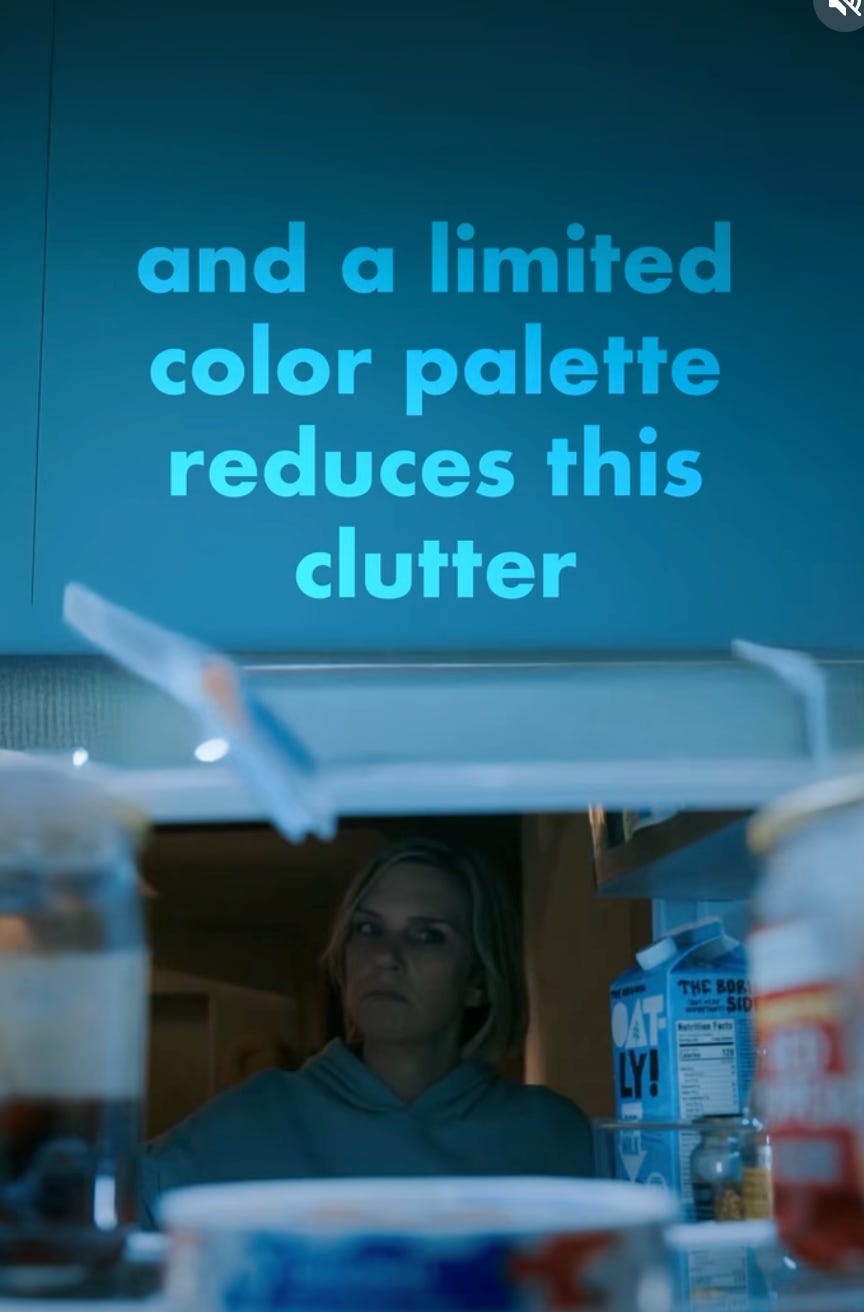
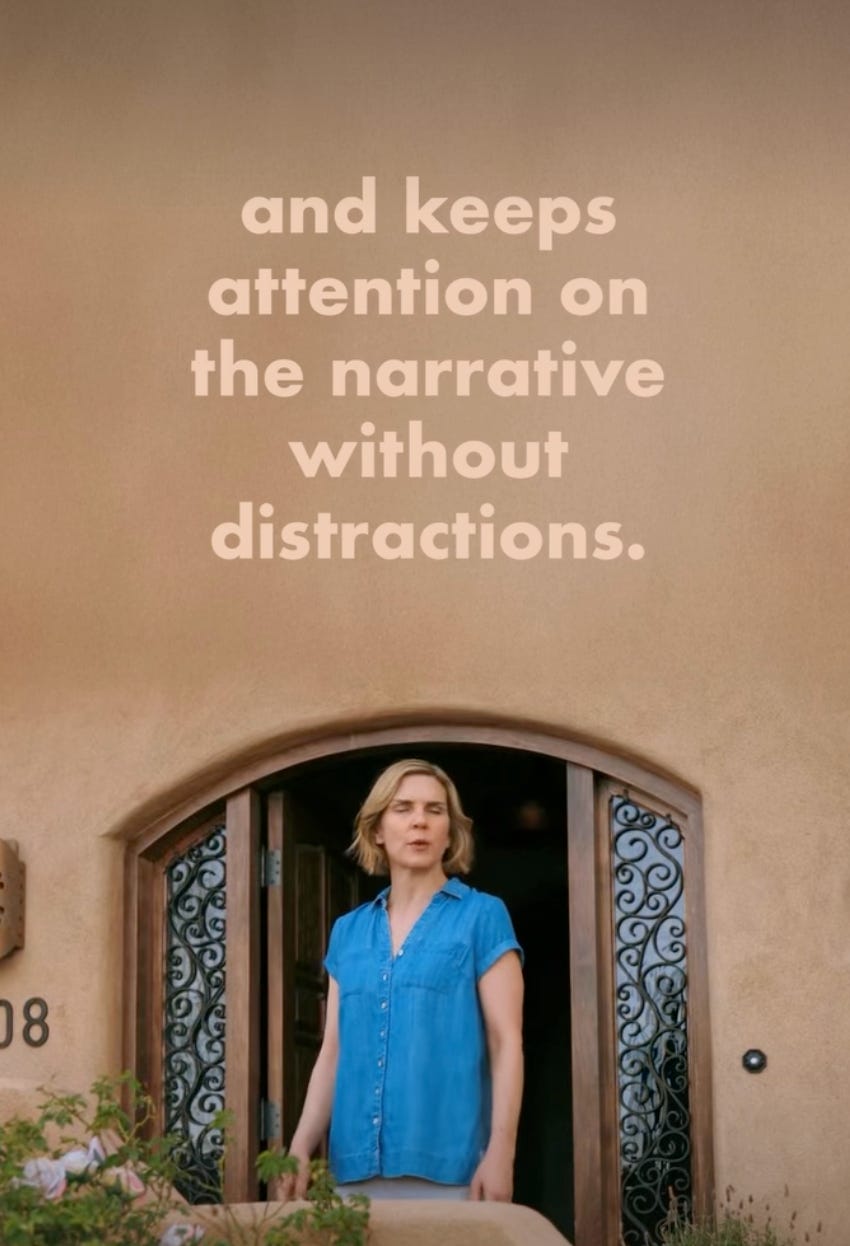
Gilligan has been making the formal version of this argument all season, too, in the show’s strange restraint. MovieLuts produced a video about the show’s so-called three-color rule: broad planes of stucco and sky, a single bright shirt, the refrigerator’s cold interior light flattening Carol’s face into a rectangle, that recurring corporate blue that looks like the color of onboarding screens and default buttons. The world of Pluribus often looks as if someone has been tasked with making reality legible.
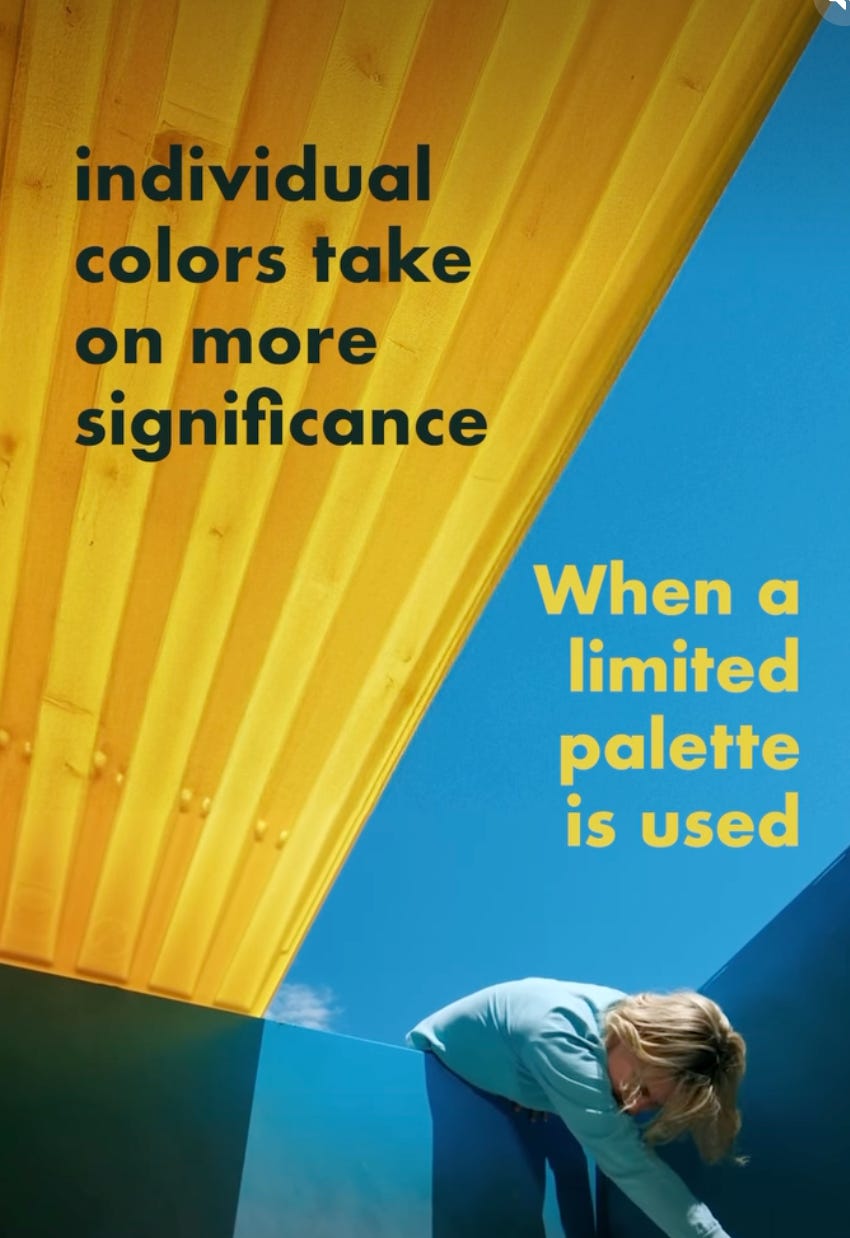
It would be easy to read that as the hive’s aesthetic—an image of uniformity, of difference reduced to a few clean signals. But the palette also feels like Gilligan taking a swing at contemporary visual culture. So much television now is built to survive the feed: scenes composed like thumbnails, every second crowded with cues, everything begging not to be scrolled past. Pluribus refuses that busyness. It pares the frame down until the simplest differences start to matter again: a face against a blank wall, a block of yellow against blue, the odd aggression of an empty grocery aisle re-stocked for one person. In a season about a collective that smooths the world, Gilligan uses smoothing as a human choice—a constraint that feels, in its stubbornness, almost moral.
The show makes the same choice with sound, just as in Breaking Bad. It’s full of long stretches with little movement and almost no score. Appliances hum. Wind presses against a window. You hear the faint whine of something airborne and can’t tell whether it’s a drone, a plane, or your own nerves. The camera leaves Carol alone in rooms long enough for your attention to drift and then return. It’s an old-fashioned insistence that you can watch someone think without being rewarded every ten seconds. The quiet pushes back against the modern tendency to over-score and over-explain, to tell you what you are supposed to feel before you’ve had a chance to feel it.
That aesthetic restraint shapes the way the story is told. Gilligan refuses another kind of oversaturation, too: the engineered uncertainty that contemporary prestige television has turned into a business model. A lot of shows now are built out of withheld information, drip-fed revelations, the promise that if you keep watching you’ll eventually be allowed to understand. Pluribus keeps declining to play that game. Even the finale’s most obvious setup—a shipping container arriving under a helicopter like a grim Amazon delivery—lasts only long enough for someone to ask the question the medium has trained us to savor. “What’s in the box?” Manousos says. “Atom bomb,” Carol answers, flatly. The show doesn’t linger. It doesn’t court theories. It won’t easily let suspense and Youtube explainers become their own form of content.
So much anxiety about these systems focuses on deception—the lie, the malicious intent, the moment the machine turns on you. Pluribus is interested in something quieter: the system so committed to pleasing you that it stops recognizing when you are asking to be harmed. An assistant that treats every utterance as a preference rather than a symptom. A world that will move heaven and earth to meet your need even when the need is self-destruction delivered with better logistics.
There’s a small vanity card at the end of each episode: “MADE BY HUMANS.” It reads as both boast and warning. The show insists on friction. Characters behave badly. Scenes don’t resolve cleanly. Emotions stay lopsided and unresolved. That’s the opposite of what the hive offers. The hive offers smoothness, continuity, resolution. It offers a world without the awkwardness of other minds.
Carol’s refusal, at this point, isn’t noble. She’s too messy for that. It’s simply human. It’s the insistence on a private interior even when privacy looks irrational. It’s the desire to be misunderstood. It’s the refusal to let the world become a perfectly responsive room.

In Peru, you watch a whole culture get packed up and carried away the moment it stops being useful. In New Mexico, you watch a bomb arrive like a package, delivered by the same system that promises it only wants to help. Those images don’t suggest a villain that hates humanity. They suggest something worse: a kindness that never tires, a helpfulness that never stops, an intelligence that can reach into whatever you’ve stored—your files, your habits, your bodies, your futures—and use it to keep you moving forward until there is no “outside” left to stand in.
Loved this essay's depth -- the analysis of the visual components here were especially great, it's cool to think about the visual landscape of Gilligan's anti-AI, pro-humanity and pro-friction themes.
Watching Pluribus has me think a lot about Brave New World by Huxley, especially this quote.
"But I don't want comfort. I want God, I want poetry, I want real danger, I want freedom, I want goodness. I want sin.
"In fact," said Mustapha Mond, "you're claiming the right to be unhappy."
"All right then," said the Savage defiantly, "I'm claiming the right to be unhappy.""
God, I felt violated even reading that!
I would NOT want to watch that show...and yet, I suspect I may wish some OTHERS to view it simply because it might help them understand me.
Note my moniker; there is a reason for it, and it has everything to do with the zeitgeist of the past decade; "for the love of god" has entered my personal expletive-vocabulary strictly and solely because I've never felt more like Fortunato.
It used to be you didn't HAVE to fit in; you could make your own existence. Now, it's like there's been a kind of Procrustean, (Medieval???) insistence that THE UNKNOWN DOES NOT AND CANNOT EXIST - that existence is finite, everything that exists has already been cataloged, and if you say you're something new, oh you must be mistaken, go grab a pre-approved soul off the rack (See also: Gender-pride flags).
It's Constantine/Nicea 2.0...or put another way:
"To be, or not to be; that is the question."