
Why Is Liberalism Adrift?
From social democracy to the Democratic Party liberalism: how parties learn to speak the language of constraint -- and what it costs them.

A holiday-length read—for those of us who don’t actually do Christmas (which, judging by my inbox, is many of you). Posting it here in case it’s useful to anyone else thinking aloud. In 1991 political scientist Adam Przeworski gave a talk to the Andalusian Confederation of Spain’s Socialist Workers’ Party. Afterward, a senior party official walked him back to his hotel. Przeworski asked why there was, despite electoral success, a “widespread atmosphere of demoralization.” The official answered in Spanish: Nos hicieron hablar un idioma que no era el nuestro (“They made us speak a language that was not ours”).
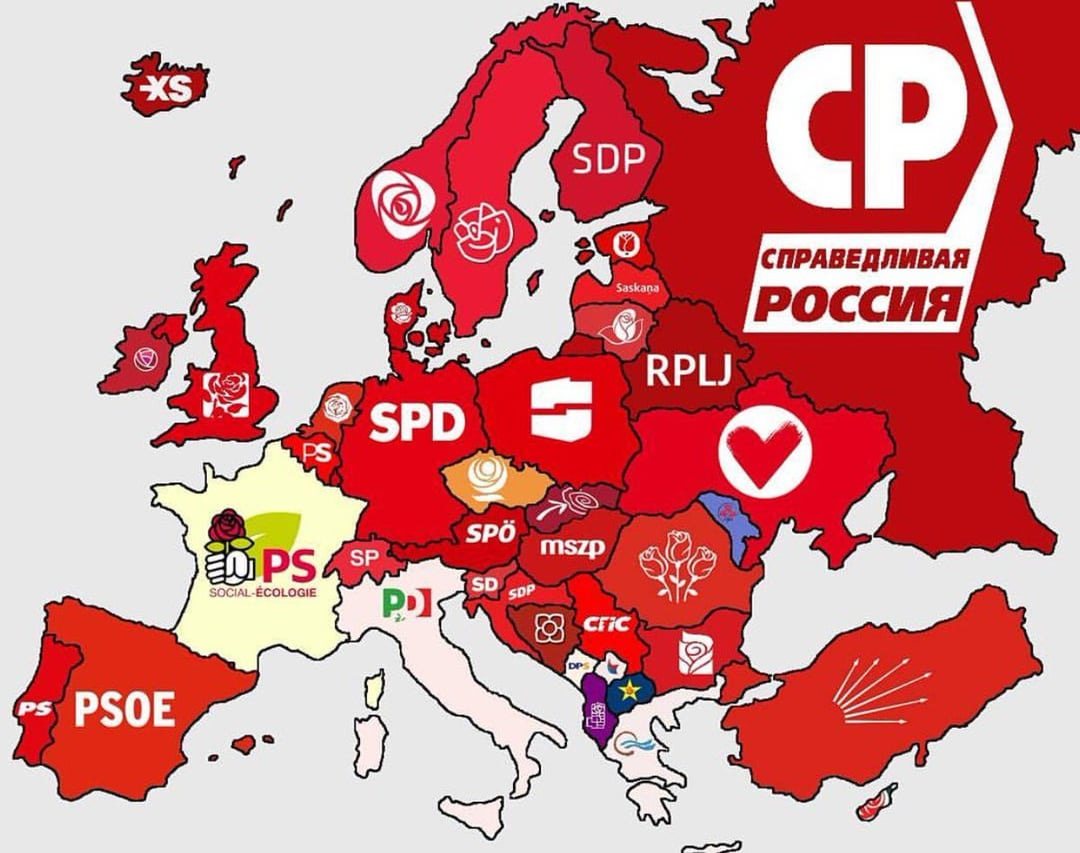
At first glance, it sounds like a complaint about messaging. In Przeworski’s telling, it’s something closer to a diagnosis: what happens to parties founded to transform society when they become responsible, year after year, for keeping a capitalist economy running.
A Language That Was Not Ours
Przeworski has spent much of his career tracing how Europe’s socialist parties, born in the late 19th century with a visionary horizon of abolishing class and making “social revolution,” entered elections, won seats, and then governed.
Looking back, the trajectory from the late nineteenth century to the late twentieth is stark. The Hague Congress of the First International in 1872 had proclaimed that the “organization of the proletariat into a political party is necessary to insure the victory of social revolution and its ultimate goal: the abolition of classes.” The first Swedish program specified that “Social Democracy differs from other parties in that it aspires to completely transform the economic organization of bourgeois society and bring about the social liberation of the working class.”
Governing forced translation. Parties that had promised a new order had to offer a program that voters would renew at the ballot box: “immediate improvements” that could plausibly be defended as steps toward a different society. Social democratic reformism, in his definition, was “the strategy of proceeding towards socialism by steps, and through electoral expression of popular support.” It was a wager that majoritarian democracy could serve as the vehicle of socialist transformation.
For a time, the wager worked. Social democrats built welfare states and labor-market institutions that turned growth into security and made redistribution feel politically sustainable. Przeworski treats the 1970s—Bretton Woods collapsing, the oil shock, stagflation—as the hinge because it forced parties to confront “distribution without surplus”: the moment, as Swedish prime minister Olof PaPalme puts it, when the absence of a “constant surplus” makes distribution “appreciably more difficult.” Even then, Przeworski notes, they didn’t capitulate immediately—they “desperately searched” for distinctively social-democratic responses—but the cushion that had made compromise easy was gone.
American Liberalism’s Settlement (and Inheritance)
That story about voice has an American echo--not because the United States ever had mass social-democratic parties in the European sense, but because the Democratic Party did build, and still largely lives off, a mid-century settlement that thickened liberalism in practice: New Deal political economy plus civil-rights liberalism as an expansion of membership. A great deal of Democratic liberalism today is defensive in the literal sense: it is organized around protecting the institutional gains of that era--Social Security; Medicare and Medicaid; labor rights and the regulatory state; the Civil Rights Act and Voting Rights Act; anti-discrimination law and due process guarantees--against austerity, privatization, and rollback. That defense is not trivial; without it, the floor drops out fast.
But it also has a political consequence familiar from Przeworski’s Europe: a governing class can begin to live on the victories of an earlier generation, treating inheritance as program. The party’s center of gravity shifts toward custodianship--guarding the settlement, protecting incumbents, policing coalition boundaries--while its forward-looking ambitions narrow. In that mode, negative partisanship becomes a substitute for a horizon: the case for power is increasingly that the other side is worse, not that this side can build something new.
For a time, New Deal and civil-rights liberalism could speak in a confident governing register because it was still constructing institutions that made citizenship materially and legally thicker. What’s fraying now is the assumption that the settlement can simply be defended and administered--that it can keep expanding, or even hold, without a renewed moral horizon, democratic institutions, and political economy capable of making those promises feel tangible under new conditions.
The Liberalism Debate After the Floor Thinned
It’s worth keeping that in mind while reading the current argument over liberalism--over “wokeness,” DEI, neutrality, due process. It often arrives as a dispute about first principles, but it is also the afterlife of a stalled settlement. Matthew Yglesias warns about an illiberal drift inside liberal institutions: neutrality treated as camouflage, procedure treated as obstruction, group-centered moral accounting displacing individual rights. Jerusalem Demsas worries about pluralism itself: whether liberalism can keep a diverse society from turning politics into permanent retribution.
Those debates feel incomplete when they hover above the larger question that New Deal and civil-rights liberalism once answered, however imperfectly: legitimacy. What does liberal democracy owe its members beyond formal equality and procedural fairness if it expects consent to remain stable? When the ground floor of life--housing, work, health--keeps giving way, arguments about norms grow feverish partly because the governing project that once made liberalism feel substantial has thinned, and the system has fewer other ways to prove it can still deliver.
Comparative politics can help here, provided it isn’t used as a travel brochure or as an escape hatch into American exceptionalism. The more valuable use is closer to what happens when you learn a foreign language late. You gain new words, but you also become conscious of what your native tongue makes easy to say, what it makes awkward, and what it quietly discourages you from saying at all.
Liberalism, Social Democracy, and a Foreign Language
Timothy Shenk begins Left Adrift with a small act of hygiene: “Political terminology is a thorny subject.” In the United States, “liberalism” often names what many other democracies would call “social democracy”: welfare states, regulation, acceptance of markets as fact rather than creed. Outside the U.S., “liberalism” frequently points in the opposite direction: open markets and individual rights, “more Milton Friedman than Elizabeth Warren.” A dictionary won’t resolve the confusion. What matters is how easily the same word can point to different political objects. American debates over “liberalism” slide between liberalism-as-rights and liberalism-as-social-protection without always noticing the slide.
Shenk presses the point further. If you want to explain why old class coalitions fractured and why today’s center-left often looks like an alliance between lower-income voters and educated professional strata, you can’t stop at slavery, Jim Crow, or white backlash, however central those are to American history. “If chronology is a problem for a strictly economic interpretation,” he writes, “then geography is a major stumbling block for the white backlash narrative.” A “unique American experience” can’t by itself explain an international shift. Once you see similar realignments across Western democracies, you have to ask what is general about late twentieth-century center-left parties and what is specific about the American route into that general pattern.
That’s why political scientist Sheri Berman and Przeworski are worth reading alongside our current liberalism debate. Their books aren’t blueprints to import from abroad, and they aren’t moral parables about what Americans should feel. They supply analytic categories for talking about legitimacy under capitalism: how markets impose discipline, how democratic consent is secured or withdrawn, and how center-left coalitions change when the promise of social protection narrows. In that framework, today’s culture-war skirmishes appear less as the main event than as one way a fraying settlement announces itself.
That’s why “a language that was not ours” is more than a lament about moderation. It names a subtler kind of drift: a party (or coalition) continues to describe itself in an old moral register--solidarity, emancipation, reform--while the practical work it’s doing has changed into something else: managing constraints, calibrating trade-offs, administering scarcity. The rhetoric remains recognizable. The referent changes. Eventually even insiders can’t tell whether familiar words still describe a mission or have become a way of making peace with retreat.
Seen in that light, the post–New Deal and post–civil rights American trajectory looks less like a morality play and more like an unfinished settlement. The United States absorbed pieces of social democracy--union rights, social insurance, welfare-state scaffolding--without developing social democracy as an ideological framework, party form, and governing common sense. It then underwent a civil-rights revolution that widened formal membership in the republic without securing the long-term political and material settlement that might have made membership durable. The result is a center-left unusually anxious and articulate about rights and procedure and far less able--organizationally and ideologically--to speak in the language of social citizenship as the default measure of freedom.
Primacy of Politics
Sheri Berman’s The Primacy of Politics argues that the defining question of modern democracy is not whether capitalism will exist, but whether democratic politics can shape it. When markets are treated as self-regulating and politics as mere referee, capitalism’s dislocations--unemployment, insecurity, the loss of social cohesion--don’t stay “economic.” They turn into political crises that democracies may not survive. Berman writes against two evasions: the laissez-faire liberal faith that the market will right itself if the state stays out of the way, and the deterministic Marxist faith that economic “laws” will deliver the future regardless of what parties and governments do. Social democracy, in her telling, emerged as a third answer: a movement that bet on politics--parties, coalitions, and state institutions--as the means to discipline markets, build social protection, and make democratic consent durable.
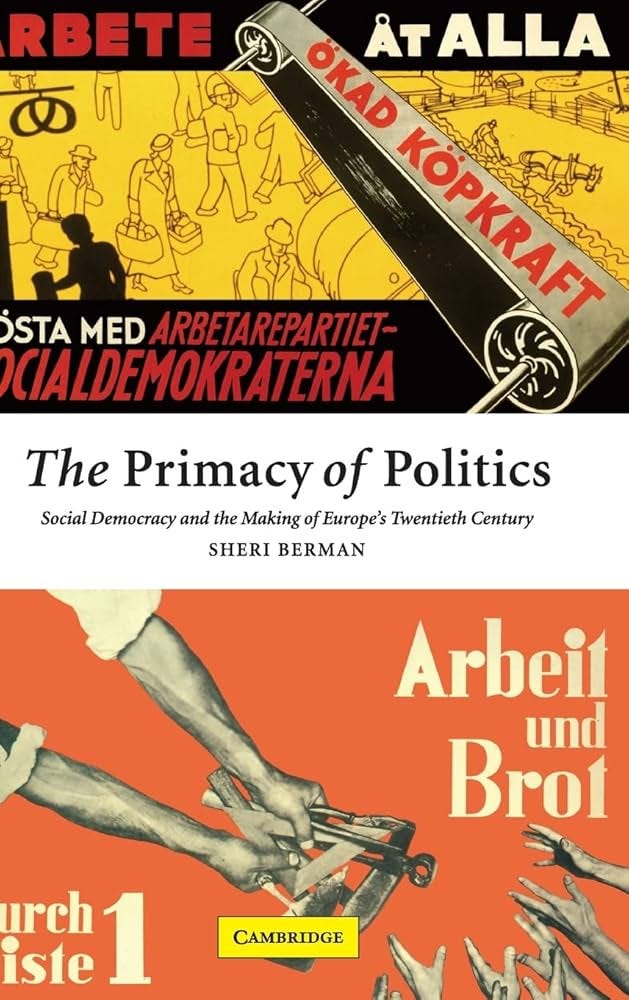
Her starting point is straightforward. Capitalism organizes dependency. It decides, in practice, who is insulated from the shocks of illness, unemployment, and old age and who is expected to absorb those shocks privately, as misfortune or failure. Liberal democracies can live with that arrangement for a while. They struggle to live with it indefinitely when those shocks become the texture of ordinary life.
Berman leans on Karl Polanyi’s “double movement” as a recurring pattern in modern politics. Market society doesn’t simply emerge; it is built and protected. “Economic liberalism,” in Polanyi’s terms, is the effort to create a self-regulating market and insulate it from democratic interference--labor protections, union power, welfare commitments, price stabilization. When that project advances far enough, Berman argues, it begins to corrode the social conditions that make democratic life stable. People start to experience basic security as contingent and negotiable. They lose confidence that sacrifice is shared, that setbacks are temporary, that losing an election doesn’t mean falling through the floor. “Social protection” is the counter-movement: unions, welfare institutions, public goods, regulations, bargaining rights--tools that re-embed markets in social obligations and make citizenship feel like membership rather than exposure.
The interwar years are her demonstration of what happens when that counter-movement fails, or arrives too late. Berman is unsentimental about fascism’s appeal. She doesn’t treat it as an inexplicable eruption of irrationality. Fascists “charged onto the stage,” she writes, by promising to put “markets in the back seat to social ones,” restoring “stability, community, and social protection.” Protection is always on offer. If democrats won’t supply it through democratic institutions, antidemocrats will supply it through institutions designed to crush democracy. The promise of social membership can be mobilized in egalitarian or exclusionary forms; Berman’s point is that liberal complacency leaves the field open to the latter.
Berman wants to show what it looked like when social democrats treated “social protection” as a governing project rather than as a moral garnish on top of liberal market society. Sweden is her clearest case not because Swedes are nicer, but because Swedish Social Democrats confronted the same interwar pressures that shattered liberal regimes elsewhere and responded with politics rather than piety. They abandoned the idea that crisis would automatically deliver a new order and treated the state as the arena in which class conflict could be organized into a workable settlement. That meant assembling a governing majority broad enough to survive, including bargains that reached beyond industrial labor to agrarians, so that protection was not a sectarian demand of unionized workers but a national program with a majoritarian base.
What Sweden illustrates, in Berman’s account, is the “primacy of politics” in the literal sense: democratic government deciding that market outcomes are not morally self-justifying, and then building institutions that make that decision durable. Social insurance turns shocks--unemployment, illness, old age--into public responsibilities rather than private catastrophes. Labor-market rules and bargaining institutions change the balance of power at the point of production instead of relying on after-the-fact charity. Countercyclical policy and public commitments aim to blunt the kind of mass insecurity that makes democratic compromise feel like surrender. Social protection becomes, in this view, the infrastructure of democratic consent. You stabilize democracy by stabilizing life. You make pluralist norms credible by making citizenship feel like membership rather than exposure.
Carlo Rosselli becomes central to Berman’s larger argument about liberalism’s unfinished business. Rosselli was an Italian anti-fascist organizer and intellectual--born into a liberal milieu, radicalized by the collapse of the old order, and murdered by fascist assassins in 1937. He founded Giustizia e Libertà, fought Mussolini as a practical enemy rather than an abstract temptation, and tried to articulate a democratic socialism that could beat both the authoritarian right and the authoritarian left. He was a socialist shaped by liberal ideals, and a liberal who concluded that liberalism, on its own terms, was failing.
Rosselli helps Berman refuse the familiar Cold War map in which liberalism equals freedom and socialism equals coercion. He understood himself as liberalism’s heir, someone trying to carry liberal promises into conditions where they had become hollow. His critique targets liberalism at its weakest point: its habit of confusing formal rights with lived freedom. He doesn’t deny liberties of conscience and political rights. He denies the complacency that treats them as sufficient. Rights, he argues, have limited value when people are “forced to live…in moral and material poverty” and therefore cannot “take any actual advantage” of those rights. Without “a minimum of economic autonomy,” liberty becomes “a mere phantasm.”
Rosselli is tightening the test liberalism sets for itself. Freedom isn’t exhausted by being left alone--by the absence of censorship, arbitrary arrest, or formal discrimination. It also has a material dimension: whether a person has enough security and independence to make choices that aren’t simply forced choices, enough room to participate in public life without living at the mercy of rent, wages, and debt. A liberal order that guarantees rights while leaving most people trapped in necessity, he suggests, is guaranteeing something closer to a paper status than a lived condition.
From that premise comes the move American political culture still tends to hear as blasphemy. Rosselli argues that liberalism historically fused its political ideals to a specific economic doctrine--what he calls “liberal free market politics”--as if free markets were the natural habitat of liberty. That fusion, in his view, converted liberalism into the moral vocabulary of a particular market order. It then mistook the market order’s stability, and the comforts it delivered to the secure, for liberalism’s fulfillment.
His conclusion follows cleanly: socialism is not liberalism’s negation but its completion, liberalism as the animating ideal and socialism as the institutional means of realizing it. A liberalism that treats the economy as beyond democratic authorship eventually collapses into linguistic and procedural righteousness, and procedure alone can’t carry democratic consent for long.
Constraint, Capture, and the Search for a Future Tense
Przeworski enters where Berman and Rosselli leave off. If they are concerned with what freedom should amount to in a capitalist democracy--the kinds of security and autonomy that make citizenship real--Przeworski is concerned with the fate of parties that campaign on those promises and then discover what governing requires. His subject isn’t “constraints” as rhetorical excuse or failure of will. It’s the hard architecture of capitalist economies: the way employment depends on investment, investment depends on profitability, and governments are forced to operate inside that chain because it is the chain that keeps people working and paid.
He states it early, almost offhandedly: “Being ‘in power’ gives little power.” The argument that follows is less a theory than a chain. In a capitalist economy, investment decisions are private. Employment depends on investment. Investment depends on expected profitability. Leave the ownership structure intact and you leave the chain intact. Unemployment then becomes not just a statistic but a political terror; parties learn quickly what happens when investment slows.
Przeworski makes the point by quoting an old piece of Social Democratic common sense--usually associated with German chancellor Helmut Schmidt--because it captures the constraint in one brutal line: “The profits of enterprises today are the investments of tomorrow…and the employment of the day after.” Przeworski isn’t endorsing the sentiment. He’s using it to name the mechanism by which capital exercises power in a capitalist democracy. When private investment drives employment, governments can tax, regulate, bargain, and redistribute, but they can’t reliably command investment without changing ownership and finance. The “veto” doesn’t usually arrive as a call from a boardroom. It shows up as the aggregate effect of ordinary decisions not to expand, not to hire, not to build, not to take risks--slowdowns that require no conspiracy because caution becomes contagious.
Social democrats consent to profits because they expect profits to be transformed into future improvements for workers--jobs, wages, security. That expectation becomes the foundation of the bargain. The party that represents labor becomes the broker and, in practice, the guarantor of a deal it does not fully control.
The trouble begins when the bargain stops delivering, or delivers unevenly, or delivers in ways that feel like insult: growth without security, productivity without wages, recoveries that show up in national accounts but not in kitchens. Parties face a choice they rarely narrate honestly. They can confront the investment veto more directly--through ownership, planning, coercive state capacity--or they can adapt to the veto and treat management as politics. Przeworski’s bleakness is not that adaptation happens once; it’s that it becomes habit. Leaders learn the tripwires. They learn that voters punish unemployment immediately and reward structural change slowly, if at all. They begin speaking the language markets reward: credibility, restraint, competitiveness. Because politics is rhetoric as well as budgets, the language doesn’t merely justify compromise; it hardens into a worldview.
That brings us back to Spain. The official’s sentence at the beginning of this piece is what it sounds like when a party formed to change the world discovers it is now defending competence at administering the world as it is.
Rights, Racism, and the Missing Social Democracy
Translate that story into the United States and you get something more mixed--Berman’s half-full and Przeworski’s half-empty at the same time. The half-full part is that the U.S. did produce, in the New Deal and the civil-rights era, a real thickening of liberalism under pressure. Labor insurgency, socialist currents, anti-colonial and Black freedom struggles forced an older rights-and-markets liberalism to absorb ideas it would have preferred to keep at arm’s length: social insurance, union power, federal responsibility for employment, and then the extension of formal citizenship across the color line. For a time, American liberalism learned to speak in a more social-democratic register, and not just as rhetoric; it built institutions that made membership materially and legally more substantial.
The half-empty part is that this thickening never consolidated into what Berman describes in Europe: a durable social-democratic party form and governing common sense that could keep disciplining markets over generations. The same two-party machinery that made the New Deal possible also made it brittle, and the same racial order that civil-rights liberalism confronted supplied veto points and backlash incentives that repeatedly narrowed what universal provision could mean. When the post-1970s constraints hit, Democrats were pulled toward Przeworski’s world of trade-offs and “responsibility” faster than they were able to renew Berman’s project of social protection as democratic statecraft.
In much of Europe, social democracy emerged as a third force--rooted in socialist movements, anchored in unions and mass membership parties--that gradually became the center-left by displacing older liberal parties and forcing conservatives to negotiate on its terrain. Even where party systems remained formally “two blocs,” social democrats changed what competition was about: the axis of legitimate politics became social protection versus market discipline, welfare and labor rights versus laissez-faire. The point wasn’t only that social democrats passed programs. They built an institutional vehicle whose identity was organized around disciplining capitalism, and whose very existence made social citizenship the language in which legitimacy had to be argued.
The United States absorbed that same impulse in a different way. Our electoral system and constitutional structure reward two sprawling coalitions, not a durable labor party that can bargain as labor against capital in its own name. So the social-democratic current--unions, urban reformers, pieces of socialist and labor politics--was folded into the Democratic Party’s big tent rather than crystallizing into a party form. Welfare programs could be built, but the welfare-state framework never became the party’s unambiguous organizing ideology; it remained one factional current among others, constantly negotiated and constantly vulnerable.
Racism turned that vulnerability into a permanent condition. The party that housed reform also housed the defenders of Jim Crow, and the coalition that made New Deal provision possible relied on a Southern one-party order whose leaders depended on racial hierarchy not only socially but institutionally, through committee power and congressional veto points. Universal provision in the American context was never just an economic question. It threatened a racial settlement. Welfare became a fight over membership--who counts as the public, who is imagined as the undeserving intruder, who deserves dignity--and that fight ensured that the most expansive version of social democracy remained politically brittle even at its moments of greatest achievement.
Mike Davis’s Prisoners of the American Dream describes this architecture unsparingly. Democrats could win elections while housing within their own coalition a brake on reform. The CIO, Davis argues, never mounted a sustained attack on the South’s “rotten borough” structure, an edifice resting on Black disfranchisement and the poll tax. Cold War discipline then reinforced coalition maintenance as the dominant imperative; unions and liberals accepted the subordination of social welfare to anti-communism and governing stability.
From Repair to Moral Management
This helps explain why American liberalism developed a different grammar than Europe’s. When I say “rights” here, I mostly mean individual, negative, and procedural rights--equal protection, free speech, due process, anti-discrimination--rather than positive economic rights to housing, health care, or employment. Those rights-and-procedure claims became the most durable route for reform because they were institutionally available even when redistribution was hostage to veto points. Courts, constitutional litigation, civil-rights statutes, procedural fairness could sometimes penetrate state institutions when Congress and party coalitions could not deliver a stable social-democratic settlement. In much of Europe, social democracy made welfare and social citizenship the master frame of legitimacy. In the United States, legitimacy was more often argued in the language of rights: partly because those claims were morally central, partly because they were the levers reformers could actually pull at scale in a system designed to make economic universalism politically brittle.
Political scientist Michael Dawson helps clarify what Black liberalism contributed to--and demanded from--this rights-centered grammar. In his account, Black liberalism carries two core commitments at once. First, a stubborn insistence that liberal principles are indispensable: constitutional rights, equal citizenship, democratic procedure are not ornamental; they are the only tools available in a country where state power has so often been used against Black people. Second, a refusal to treat those principles as self-enforcing or sufficient: because American institutions are structured by racial hierarchy, rights on paper have repeatedly failed to produce freedom in fact. Black liberalism is therefore simultaneously normatively liberal and institutionally skeptical--committed to universal rights while insisting that those rights must be backed by organized power and, often, by material guarantees (jobs, housing, welfare) if they are to become real rather than merely declared.
Dawson’s starting point is methodological: ideology is not just a platform; it’s the hand-me-down vocabulary available for naming experience. That matters for Black liberalism because it explains how one can remain committed to liberal rights as indispensable while also treating liberal institutions as structurally untrustworthy--two commitments that look contradictory only if you treat ideology as a coherent “doctrine” rather than as a repertoire forged under unequal power.
Cedric Johnson’s account of postsegregation Black politics helps explain what happened once this rights-centered, institutionally skeptical tradition became the dominant channel for reform, but the material program that might have completed it did not. “Black Power,” he argues, named the possibility of a more thoroughgoing reckoning. In practice, the terrain shifted. As formal segregation fell, the federal government and liberal foundations opened new channels--War on Poverty programs, community action funding, legal services, “maximum feasible participation,” later nonprofit contracting--that brought movement leaders and their constituencies into regular contact with state agencies, grant rules, professional staff hierarchies, and administrative timelines. For many civil-rights organizers, this wasn’t co-optation so much as a hard-won opening: a chance to secure resources, build services, gain a foothold inside government, and protect communities in a moment when direct confrontation met repression and the most urgent needs were immediate.
Johnson’s point is that these openings came with a shape. They encouraged a “moderate form of political subjectivity” geared toward program administration, representation, and incremental gains, and they trained a new stratum of Black officials and advocates fluent in the language of governance. That institutionalization--what he calls “technologies of citizenship,” programs designed to make people politically active and capable of self-government while also regulating and channeling their activity--helped convert insurgent movement energy into a politics of participation and brokerage inside existing institutions. The result wasn’t simply the triumph of cynical elites; it was the predictable outcome of pursuing liberation through funding streams, policy programs, and professionalized access in a period when redistributive ambitions were already running into coalition limits and backlash.
Elite Capture, Party Anchors, and the Way Out
Placed back inside the larger arc of this essay, Johnson’s story becomes a domestic version of the drift Berman and Przeworski describe. When the center-left cannot, or will not, build the material floor that would make citizenship substantive, politics doesn’t vanish. It changes medium. It migrates toward institutions that can distribute recognition, administer procedures, and manage participation more easily than they can deliver jobs, housing, or economic autonomy. “Voice” becomes a program. Representation becomes a stand-in for power. Procedural inclusion becomes the most stable kind of victory. The result is politics that can be intense and vivid inside institutions and oddly weightless outside them--precisely the conditions under which today’s liberalism debate ends up staged as a fight over language and norms rather than over social citizenship.
That background also helps explain why today’s conflict so often gets staged as “wokeness versus liberalism.” When a society emerges from an apartheid-like order--formal exclusion dismantled, equal citizenship declared--there is usually a second phase: some combination of redistribution, reconstruction of public goods, and state capacity strong enough to make equality durable. In the United States that second phase never fully arrived. The civil-rights revolution won legal inclusion, but the effort to extend the welfare state and build a real material floor--jobs, housing, schools, health--was blunted, fragmented, and eventually rolled back. There was no American equivalent of a truth-and-reconciliation process paired with a governing program of repair. What remained was a moral reckoning without a structural settlement.
In that vacuum, institutions reach for the tools they actually control. They can’t reliably deliver redistribution, but they can regulate behavior. They can’t build housing, but they can rewrite norms. They can’t guarantee security, but they can promise recognition. Politics migrates into the domains where administrators, universities, nonprofits, and employers can act: trainings, rubrics, language rules, workplace discipline, public shaming, the policing of tone. “Privilege exercises” and etiquette regimes become substitutes for the harder work of changing material conditions. This is the ecosystem that produces many of the practices Yglesias calls illiberal or “postliberal”--not because language never matters, but because when the state and party system can’t deliver a program of repair, the most visible form of action becomes the management of speech, conduct, and symbolic standing.
Treating the “postliberal” phenomenon primarily as ideological invasion--postliberals smuggled into liberalism’s house--misses something more ordinary and more plausible. Institutions do what they can do, and the center-left increasingly lives in institutions.
Olúfẹ́mi Táíwò and Musa al-Gharbi help explain why a liberalism that struggles to deliver material security so often ends up fighting over symbols, speech, and institutional etiquette instead. Táíwò’s central claim is that “identity politics” is not automatically radical or automatically corrupt; it is vulnerable to elite capture. When moral languages travel into large institutions—universities, nonprofits, foundations, media organizations, corporations—they get filtered through institutional incentives: what can be measured, litigated, enforced; what lowers organizational risk. The result is not always cynicism. It is often narrowing. Problems that can be handled internally—personnel decisions, trainings, language rules, reputational enforcement—crowd out problems that require redistribution, mass organization, or conflict with concentrated economic power. The vocabulary stays lofty; the practical horizon contracts to what institutions are set up to do.
Al-Gharbi adds the sociological layer that makes this especially relevant for the Democratic coalition. His argument is that the most visible carriers of this moral language are not “the marginalized” as such but a professional class he calls symbolic capitalists: people who make a living producing, managing, or policing meaning—through education, media, nonprofits, HR and compliance systems, consulting, the cultural industries. Their influence is real, but it is exercised through cultural and administrative tools rather than through control over investment and production. As the Democratic coalition becomes increasingly staffed, funded, and culturally led by these institutions and strata, its most intense internal conflicts predictably take the form those tools encourage: battles over speech, status, legitimacy, procedural fairness, moral authority. That, in turn, gives the right an opening it is always eager to exploit: to recast liberalism not as a project of social protection or democratic membership, but as a scolding elite morality that can regulate language while failing to regulate rents.
What remains is the organizational reason this pattern reproduces itself, even when party leaders say they want to “refocus on the economy.” Daniel Schlozman and Sam Rosenfeld’s language of party “anchors” is useful here because it shifts attention from what parties claim to value to what, institutionally, holds them in place. Anchors are the large social organizations that supply a party with voters, leaders, money, and ideas—unions, churches, civic federations, business associations—and in doing so quietly determine what a party can plausibly fight for and how it measures success.
Look at the Democratic Party through that lens and “Democratic liberalism” starts to resemble less a coherent ideology than the product of an anchoring shift. As the old, dues-paying working-class anchors weakened—above all organized labor—the party’s center of gravity moved toward professional advocacy groups, nonprofits, donor networks, and media-adjacent institutions. Those anchors are influential, but they operate inside elite arenas: litigation, messaging, coalition brokerage, reputational enforcement, incremental regulatory wins. In a system thick with veto points and capital discipline, they can keep functioning even when redistribution stalls. The result is a party that becomes very good at negotiating among constituencies and very uneven at constructing a shared, majoritarian project capable of delivering material provision at scale—because its anchors no longer train it, day after day, to do that kind of politics.
What comes next for a liberalism drifting at sea after cutting loose its anchors?
It’s tempting to treat these scholars as chroniclers of decline, anatomists of a center-left that lost its nerve and learned to speak in the language of constraint. But they are making a more demanding claim. Berman’s point is that social democracy mattered not because it administered the postwar order more competently than its rivals, but because it expanded what publics thought politics could do. It offered, in her phrase, “a sense of the possible.” When parties stopped trying to transform the terms of everyday life and began selling themselves as responsible managers, they didn’t merely change their messaging; they shrank the horizon of democratic legitimacy. A center-left that can’t name a future, and can’t explain how today’s reforms accumulate into that future, will be outbid by movements that can, even if what they offer is exclusion rather than equality.
Watch the Latin American center-left right now and you see something the Atlantic world’s center-left has largely forgotten how to do: govern as if social citizenship is a construction project, not a memory. The interesting feature isn’t simply that these governments are spending more; it’s that they are trying—unevenly, under constraint—to fuse redistribution with postcolonial membership claims that can’t be satisfied by etiquette.
Claudia Sheinbaum’s Plan México is pitched as industrial policy and state-led development with poverty reduction built into the growth model—an effort to steer investment rather than merely soften its outcomes. Alongside that economic agenda, she has used the presidency to recode national symbolism, publicly acknowledging the National Palace as built atop an Indigenous burial ground and declaring a national Year of the Indigenous Woman as part of a broader attempt to redefine who the Mexican state is for.
In Brazil, Lula’s third term has paired the restoration of mass anti-poverty capacity (Bolsa Família’s relaunch) with explicit racial inclusion inside the federal state, through measures that reserve senior trust positions and expand Black representation in public employment—an attempt to make the bureaucracy itself look less like a private club, not merely to diversify corporate HR. Uruguay’s Frente Amplio under Yamandú Orsi is pursuing a more technocratic version of the same balancing act—keeping macro stability while foregrounding inequality and multidimensional poverty as problems of legitimacy, not just social policy. And Arévalo’s Guatemala highlights the prior condition most European and American discussions take for granted: before you can build a welfare bargain, you need a state that isn’t openly captured by oligarchic networks—a struggle sustained by civil society and Indigenous mobilization that treats democracy itself as a fight over who the state belongs to.
The “woke” constitutional backdrop makes the ambition explicit in a way U.S. liberalism rarely does. Bolivia’s 2009 constitution declares a plurinational state and codifies Indigenous rights alongside social rights; Ecuador’s 2008 constitution builds out the language of buen vivir as an organizing principle of social membership. These texts don’t guarantee outcomes. But they clarify what the best moments of the New Deal and civil-rights era also suggested: center-left liberalism is strongest when it can integrate radical challenges—socialist, anti-colonial, racial egalitarian—into institutions that make equality materially usable, rather than letting those demands survive only as moral language inside elite spaces.
The Spanish official’s lament at the start of this piece wasn’t really about rhetoric. It was about credibility. The task isn’t to recover a lost language for its own sake; it’s to rebuild the political conditions that make a different language believable. That means a liberalism capable of defending due process and pluralism while also rebuilding the social-democratic capacity to make membership mean something material again. Without that, the center-left will keep oscillating between procedural defense and symbolic management, and then wondering why neither dialect persuades people whose daily experience is exposure.
The unfinished work of the republic is not merely that America failed to live up to its creed; it is that we did, for a brief interval, produce a set of “founders” of a newer order—architects of civil-rights liberalism and radical egalitarianism—without ever completing the settlement their victories implied.
The civil-rights generation did not only win moral arguments; it forced constitutional reconstruction in practice: formal citizenship widened, public authority pushed (however imperfectly) against private and local tyranny, the state briefly spoke in a language that linked rights to material provision.
But the second half of their project—the effort to make those rights economically durable through unions, full employment, housing, and a social floor—never hardened into a common sense, ideological framework. The Reagan Revolution didn’t have to repeal the Civil Rights Act to defeat that broader ambition; it starved the welfare state, broke labor’s bargaining power, sacralized the market, and turned “government” itself into the object of suspicion.
What we’re left with is a republic that can still recite its creed. The words are there—rights, equality, citizenship—engraved in statutes, repeated in speeches, invoked in courtrooms. The commemorations still arrive on schedule. But the institutions that were supposed to translate that language into an ordinary experience—strong unions, abundant public goods, a state willing to treat security as a governing purpose—have thinned or decayed. The result is a familiar American dissonance: constitutional commitments that remain intact in text while the political economy beneath them keeps making those commitments harder to inhabit.
Liberalism, in that condition, resembles a vessel that still knows the rules of seamanship but has lost a governing project—a destination that makes sacrifice intelligible and compromise credible. It can enforce norms on deck; it can insist on procedure; it can warn, correctly, about the rocks. What it struggles to supply is a plotted route and the capacity to hold it: a story in which reforms accumulate into security and security into consent.
Nos hicieron hablar un idioma que no era el nuestro—they made us speak a language that was not ours. The line is less about tone than about legitimacy: a politics can keep repeating the old vocabulary of freedom long after the institutions that once made it credible have thinned out. As liberal institutions lost the capacity to guarantee security at scale, they grew more adept at regulating conduct. Citizenship did not lose its moral force, but it was increasingly administered through procedure rather than backed by protection.
In that gap, shared by twentieth-century European social democracy and the Democratic Party’s New Deal–civil-rights inheritance, liberalism becomes adept at specifying limits on power—what must not be done, how authority should behave—while losing the capacity to articulate and sustain a governing project that makes membership materially real. When the voyage becomes “avoid catastrophe” rather than “reach somewhere,” the hunger for a destination doesn’t disappear; it gets captured by pirates who promise a harbor and call it order.
The core problem we need to face and deal with is the false belief that gives rise to an economic system "capitalism", which in turn produces a governing system that is anti-democratic.
The false belief is that people who are able to acquire and accumulate ever-increasing wealth, are somehow superior to everyone else, and should be in charge of running everything. That is the core belief of capitalism, which is the economic system that our Constitution was written to protect and actively promote! While "capitalism" is not mentioned by name in the Constitution, it's core belief gave rise to our Constitution and the framework of the US government.
Most people think that our Constitution was set up to make sure we never have a king… and while that's true, it was also NOT set up to give all the power to the people as a whole. It was set up to give all the power to the wealthy NON-Royal PROPERTY OWNERS… NOT the working class… NOT the slaves… and NOT the employees... but to give that power to the EMPLOYERS!
So while our system of government was set up to guard against any Royal hierarchy, it was also guarding against any takeover by employees and slaves!
We have an Executive branch with a President who is the Commander in Chief! That means the President is part of the military and gives all the orders… a totally top down hierarchy! Nothing democratic there.
We have a Senate, which is the antithesis of democracy (set up with 2 Senators per state, so that some votes count hundreds of times more than others). I call it the UNdemocratic Senate.
We have a Supreme Court, with members who are not elected. Instead, they are appointed by the President with only the UNdemocratic Senate’s approval. It also has no way to enforce its decisions, and its justices can only be removed by agreement of both the House and the UNdemocratic Senate.
We have a House, which has no power to remove a President or Supreme Court Justice unless the UNdemocratic Senate agrees.
So our Executive branch is virtually all-powerful because the President is immune to impeachment and removal from office unless the UNdemocratic Senate (as well as the House) agree.
Therefore, the so-called "balance of power” exists in name only. There is virtually NO way to enforce it! Our Constitution ignores the fact that it is the Constitution itself that set up our electoral system, which ensure that it will ALWAYS be the richest who hold the majority of seats in all branches of our government!
This should not surprise us, since our Constitution was written by the richest adult white males in the colonies, and was written to protect their property and their right to continue hoarding more and more wealth (which at that time, included enslaved human beings, most of whom were not white, and some who... even though white…. were so poor that they had to become “indentured” to survive).
So, despite all the wonderful “equality"language of our “Proclamation of Independence”…. the ONLY humans our Constitution gave any rights to, were rich adult white males…… NOT democracy by any stretch of imagination!
If we continue to ignore and/or refuse to remedy the massively flawed assumptions that gave rise to our Constitution and economic system…. we will NEVER escape being ruled by the richest narcissists, because they are precisely who are rewarded the most under capitalism! It rewards those who are the most ruthless in raking in more and more wealth regardless of who is harmed in so doing!
I realize that many on the left are fearful that any action to rewrite our Constitution could result in the "right" rewriting it in the way they want, which would certainly not be to make it more democratic. But if you do harbor that fear, I ask you 2 questions:
1. Do you believe that to have a fair and just government, all people should have the same rights under law, and that in order for the law to be really fair and just, it must be created by a consensus (or at least a strong majority) of all the people governed?
2. If you do believe this, then why do you NOT believe that the majority of people in the USA can create a new Constitution that is truly fair and just? Why do you believe that coming together as a collective whole, for the first time in our country's history, would NOT result in an improved, fairer, and more just Constitution? In other words, if you really believe in democracy (which means you believe that as a whole, most people are fair and just) then how can you NOT believe that those same fair and just minded people would not prevail in a rewrite of the Constitution?
Bravo! A brave and compelling exegesis of the limits of ‘negative liberalism’ in the US context. This essay should be compulsory reading for every hand wringing pro democracy ‘resistance lib’ in the polity.